
India Achieves Milestone Higher Education Growth and Skill Integration Leap, Says Ministry Report
The report underscores the government's strategic initiatives aimed at building a skilled, inclusive, and innovative educational framework aligned with the "Viksit Bharat" vision.
NEW DELHI: The Ministry of Education has released a comprehensive overview highlighting major advancements in skill integration and enrollment growth within India’s higher education ecosystem. The report underscores the government’s strategic initiatives aimed at building a skilled, inclusive, and innovative educational framework aligned with the “Viksit Bharat” vision.

Key Pillars of Educational Transformation
Skill Integration
-
- Vocational emphasis: The Ministry of Education is placing a renewed emphasis on vocational education to bridge the gap between traditional academics and practical training. By integrating hands-on skills directly into the academic curriculum, institutions aim to better prepare students for the modern workforce.
- Lifelong learning: Current initiatives are heavily focused on enhancing student employability through continuous learning pathways. This approach encourages students to cultivate adaptable skills that remain relevant throughout their entire professional careers.
- Framework alignment: To standardize educational quality, the National Higher Education Qualifications Framework (NHEQF) is now systematically aligned with the National Credit Framework (NCrF). This structural integration simplifies credit transfers and creates a more cohesive national education system.
- Degree integration: The introduction of the Internship/Apprenticeship Embedded Degree Programme (IEDP) marks a significant shift toward experiential education. This initiative blends formal degree tracking with real-world corporate apprenticeships to maximize practical exposure before graduation.
Skill integration in higher education
The Ministry of Education is aligning learning with industry needs through research, innovation, flexible curricula and inclusive access initiatives under #NEP2020.
These initiatives were highlighted in the information given by the Minister… pic.twitter.com/64rrEX2K90
— Ministry of Education (@EduMinOfIndia) July 26, 2026
Skill Development Initiatives
- AICTE strengthening: The All India Council for Technical Education (AICTE) has significantly reinforced its regulatory and supportive measures to upgrade technical education across the nation. These efforts ensure that technical institutions maintain high training standards that match global benchmarks.
- Industry partnerships: Higher education institutions are rapidly expanding their collaborations with corporate leaders to deliver specialized online skill courses and certified internships. These partnerships directly connect academic coursework with real-time industry demands.
- Future readiness: Educational programs are increasingly emphasizing practical, hands-on skills along with deep exposure to Industry 4.0 technologies. Students are trained to work alongside advanced automation, big data, and smart manufacturing systems.
Digital Learning & Apprenticeship
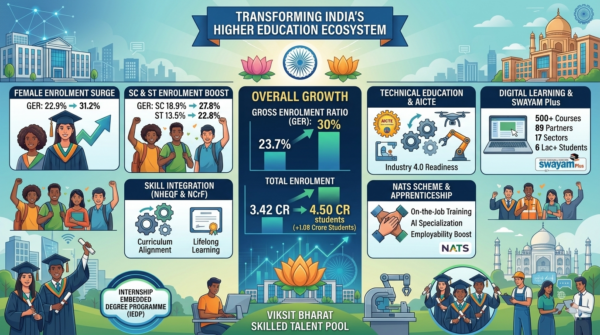
- SWAYAM Plus: The SWAYAM Plus platform has expanded rapidly, now hosting over 500 specialized courses designed in collaboration with 89 industry partners across 17 distinct sectors. The initiative has successfully registered more than 6,0,000 students, vastly broadening access to quality digital education.
- NATS Scheme: The National Apprenticeship Training Scheme (NATS) focuses on providing structured on-the-job training and apprenticeship-embedded degrees to young professionals. The scheme places special emphasis on equipping students with expertise in cutting-edge, emerging sectors like Artificial Intelligence.
Remarkable Growth in GER and Total Enrolment
Data comparisons between the academic years 2014-15 and 2023-24 reveal significant leaps across multiple demographics, showcasing a more inclusive student landscape:
- Overall GER: India’s Gross Enrolment Ratio (GER) witnessed a substantial upward trajectory, climbing from 23.7% in the 2014-15 academic year to 30% by 2023-24. This growth reflects a broader national mobilization toward making higher education accessible to a larger segment of the population.
- Female GER: A major highlight of the report is the surge in female enrollment, with the female GER rising from 22.9% to 31.2% over the decade. This milestone indicates a positive shift in gender parity and increased educational opportunities for women across the country.
- SC GER: Educational inclusivity initiatives have yielded strong results for Scheduled Caste (SC) students, whose GER jumped from 18.9% to 27.8%. This significant increase underscores the impact of targeted financial and academic support systems for computationally marginalized communities.
- ST GER: The Gross Enrolment Ratio for Scheduled Tribe (ST) students also saw remarkable progress, rising from a baseline of 13.5% up to 22.8%. The steady increase reflects successful outreach and infrastructure development in remote and tribal regions.
- Total Enrolment: Total higher education enrollment in India expanded from 3.42 crore students to an impressive 4.50 crore students over the tracked period. This massive expansion means that over 1.08 crore additional students entered college classrooms, significantly boosting the nation’s highly educated talent pool.
Comments are closed.