

India’s higher education system has grown rapidly over the past decade, with 1,289 universities, 48,246 colleges and 15,221 standalone institutions recorded in FY24. This marks a 47% rise in institutions since FY14, according to SBI research’s report titled ‘The State of Higher Education in India since 2014’. Student enrolment has surged to 4.5 crore, reflecting the scale of expansion.

Yet, this growth has been accompanied by a serious shortfall in teaching staff. The report highlights that 34% of sanctioned teaching posts remain vacant across centrally funded institutions, raising concerns about quality and capacity.
14,000 Vacancies Across Key Institutions
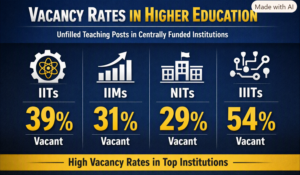
Data from the Parliamentary Standing Committee on Education shows 14,042 of 41,351 sanctioned posts are unfilled. Vacancies vary sharply across institutions:
IIITs: 54% vacant
IITs: 39% vacant
Central Universities: 33% vacant
IIMs: 31% vacant
NITs: 29% vacant
IISERs: 7% vacant
Alarmingly, over half of professor-level posts (56.2%) remain vacant, underscoring the challenge of attracting and retaining senior faculty.
Student-Teacher Ratio Highlights Regional Gaps
India’s overall pupil-teacher ratio in higher education stood at 23:1 in FY24, but state-level disparities are stark.
Tamil Nadu, Kerala, Goa: 14:1
Delhi: 20:1
Rajasthan: 25:1
Uttar Pradesh: 33:1
Jharkhand: 48:1
Bihar: 57:1
The Parliamentary Standing Committee has recommended a 15:1 ratio as ideal, making Bihar and Jharkhand’s figures particularly concerning.
Spending Stagnates at 1% of Budget
Government expenditure on higher education rose from ₹23,152 crore in FY15 to ₹55,727 crore in FY27 (BE). However, its share of total expenditure has stagnated at around 1%, down from 1.6% in FY18. SBI Research has urged raising this to 1.5%, alongside stronger academia-industry collaboration and investment in research.
Vocational Training Still Limited
The report also flagged gaps in vocational training. While participation among youth aged 15–29 rose to 30.7% in 2025 (up from 7.1% in 2018), the figure remains below global benchmarks. Gender disparities persist, with 39.9% of young men receiving training compared to 21.2% of young women.