
How To Choose Postgraduate STEM Courses In India: Know The Best Five Institutes
India’s top-tier institutions offer specialised PG programmes designed to keep students aiming to build a future-proof, high-trajectory career on the right track

NEW DELHI: STEM education—Science, Technology, Engineering, and Mathematics— in India has evolved. Transgressing learning from textbooks, it has embraced a hands-on approach focused on solving real-world problems.

Instead of just learning formulas and understanding concepts, students now use emerging technology tools such as artificial intelligence, robotics, and data analytics to tackle real challenges.
The traditional separation between science, technology, engineering, and mathematics has blurred and been replaced by an interdisciplinary approach with a focus on creativity and critical thinking.
This transformation ensures that students are not just learning theories or formulas, but are preparing themselves for the future digital workforce.
For an ambitious STEM graduate, a standard postgraduate degree is not enough to ensure a high-impact career. The growth now is in emerging technologies such as generative artificial intelligence (AI), semiconductor design, quantum computing, and synthetic biology.
If you are a student aiming to build a future-proof, high-trajectory career, India’s top-tier institutions offer specialised tailor-made postgraduate programmes designed to place you at the frontier of innovation. But the big question is: what criteria should you use to choose a programme?
Metrics for selecting a course
The following are some criteria which help you zero in on the right institutions.
Dedicated advanced centres: Do not fall for the universities that simply add an AI or Robotics elective to a traditional syllabus. Look for the institutes with dedicated, government-funded or industry-backed centres of excellence.
Computational and lab infrastructure: Emerging technology needs intense computing power. Ensure your target institutions provide access to high-performance computing (HPC) clusters, cleanrooms for chip design, or specialised bio-safety labs.
Patent and industry pipelines: A high-impact PG programme should not culminate in a static thesis. It should lead to published research, patent filings, or venture-backed incubation.
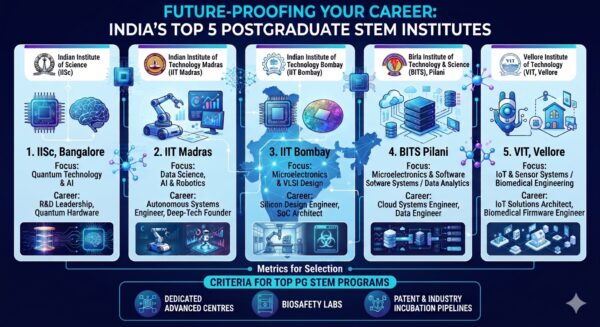
Here are the five post-graduate programmes in emerging technologies that promise a bright career. The institutes have been curated based on their flagship programmes, focus and course trajectory.
- Indian Institute of Science (IISc), Bangalore
- Flagship programme: M.Tech in Quantum Technology / M.Tech in Artificial Intelligence
- Focus: IISc approaches emerging tech from a deep-tech, foundational engineering perspective.
The Quantum Technology programme bridges the gap between quantum physics and practical computational systems, while the AI track focuses heavily on mathematical modelling and machine learning theory.
- Career trajectory: Core research and development (R&D) leadership roles, quantum hardware engineering, and elite global industrial research labs.
- Indian Institute of Technology Madras (IIT Madras)
- Flagship programme: M.Tech in Data Science and AI / Interdisciplinary M.Tech in Robotics
- Focus: Operated alongside the Robert Bosch Centre for Data Science and AI, this curriculum focuses heavily on real-world implementation. The robotics vertical bridges mechanical design with edge computing, computer vision, and autonomous navigation.
- Career trajectory: Autonomous systems engineer, AI architect, and deep-tech startup founders via the IITM Incubation Cell.
- Indian Institute of Technology Bombay (IIT Bombay)
- Flagship programme: M.Tech in Microelectronics and VLSI Design
- Focus: As India pushes for domestic semiconductor manufacturing, this program stands out as a critical tech driver. It covers the entire lifecycle of hardware creation, from device physics and fabrication to complex chip architecture and embedded software.
- Career trajectory: Silicon design engineer, semiconductor specialist, and system-on-chip (SoC) architect for global tech firms.
- Birla Institute of Technology & Science (BITS), Pilani
- Flagship programme: M.E. in Microelectronics / M.E. in Software Systems (with Data Analytics specialisation)
- Focus: BITS Pilani blends rigorous technical instruction with an unparalleled corporate pipeline. The curriculum is continuously updated to reflect modern shifts in software deployment, cloud infrastructure, and next-generation communication networks.
- Career trajectory: Cloud systems engineer, data engineer, and systems developer, fast-tracked by BITS’ mandatory corporate Practice School.
- Vellore Institute of Technology (VIT), Vellore
- Flagship Programme: M.Tech in IoT and Sensor Systems / M.Tech in Biomedical Engineering
- Focus: This programme addresses the massive explosion of smart devices and digital health informatics. It focuses on smart infrastructure, edge-computing nodes, biosensors, and wireless communication protocols required for next-generation automated networks.
- Career trajectory: IoT solutions architect, biomedical firmware engineer, and smart systems designer.