


New Delhi: The country has added 34,840 colleges and 980 universities since 2001, according to a new report by education advisory firm Jetri and non-profit platform Impacatica.org.

While the number of colleges per lakh people in the 18–23 age group has risen from nine to 37, the expansion has not matched the geographical spread of India’s youth population.
The report, Geography of Higher Education in India, warns that states with rapidly growing young populations risk widening disparities unless institutional capacity expands in line with demographic demand.
Bihar, UP, Jharkhand Lag Behind
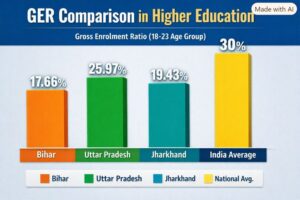
The study highlights Bihar, Uttar Pradesh and Jharkhand as states where higher education infrastructure falls short. Despite large youth cohorts, these states have relatively low college density and Gross Enrolment Ratios (GER) well below the national average of 30%.
- Bihar: GER 17.66%, 1,175 colleges, 37 universities
- Jharkhand: GER 19.43%, 425 colleges, 34 universities
- Uttar Pradesh: GER 25.97%, 8,310 colleges, 91 universities
A NITI Aayog report (February 2025) similarly found Uttar Pradesh had just 0.3 universities per lakh youth, compared with the national average of 0.8.
Institutions Clustered in Select Districts
The imbalance is stark at the district level. Just 20 districts host 28% of India’s universities, while college density is concentrated in established hubs.
- Bengaluru Urban: 1,225 colleges
- Jaipur: 809 colleges
- Sikar: 374 colleges
- Azamgarh: 338 colleges
- Belagavi: 317 colleges
Overall, 173 districts have 100 or more colleges, underscoring the clustering of higher education capacity in western, southern and northern regions, while the east and northeast remain underserved.
Call for Demand-Aligned Expansion
The report urges policymakers to align future expansion with emerging demographic centres, particularly in Bihar, Uttar Pradesh and Jharkhand. It recommends building ecosystems of universities and colleges with regional connectivity rather than isolated institutions.
“India has already demonstrated that it can build higher education at scale. The next test is precision: understanding where future students will be, where capacity is weakest and where new institutions can have the greatest impact,” said Shreyasi Singh, Managing Partner at Jetri.
Comments are closed.