
GST Reforms 2025: Check Key Takeaways For Education Sector
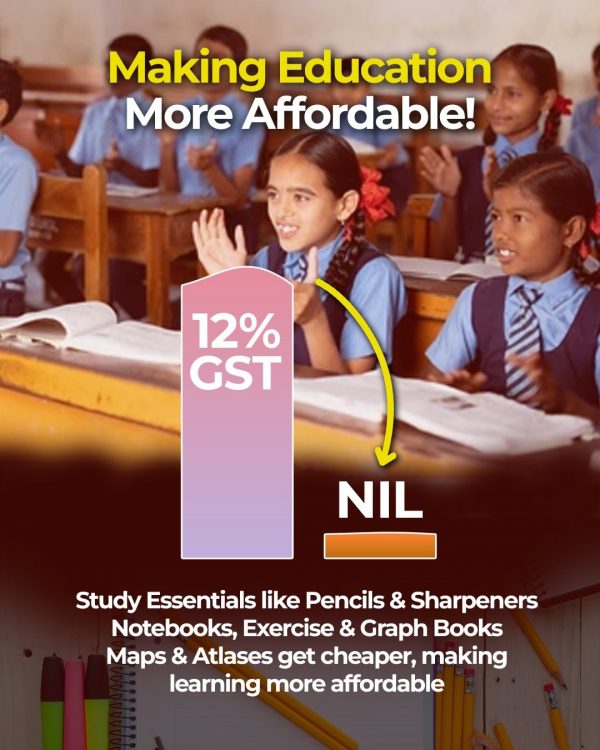
Essential study materials such as exercise books, pencils, erasers, crayons, and sharpeners will now attract zero GST

NEW DELHI: The recent GST reforms and two-slab tax announced by Union Finance Minister Nirmala Sitharaman after the 56th meeting of the GST Council on September 3, is expected to bring some relief to the education sector.
The reforms offer relief to students, as essential study materials such as exercise books, pencils, erasers, crayons, and sharpeners will now attract zero GST.
Additionally, items like geometry boxes, school cartons, and trays have been shifted from the 12% slab to 5%. This reduction is expected to make learning essentials more affordable, ease the financial burden on families, and improve access to education.
The new GST structure, effective from September 22, will have two tax slabs: 5 per cent and 18 per cent. Sweeping rate cuts will apply across agriculture, MSMEs, healthcare, labour-intensive industries, and households.
“The NextGenGST reforms will have a transformative impact in making education more affordable as well as delivering more value,” Union Education Minister Dharmendra Pradhan posted on social media platform X.
Detailing the GST reforms, he said formal education sector (schools and universities) were already exempt from GST. Nil GST on educational services, books and learning aids, GST rate cuts on toys & sports goods (12% to 5%), bicycles (12% to 5%) and buses (28% to 18%) will make educational materials, student mobility and transportation cheaper.
#NextGenGST reforms will have a transformative impact in making education more affordable as well as delivering more value.
Formal education sector (schools and universities) were already exempt from GST. Nil GST on educational services, books and learning aids, GST rate cuts… pic.twitter.com/6rOhk9sACN
— Dharmendra Pradhan (@dpradhanbjp) September 4, 2025
These reforms and rate reductions will kick-start a virtuous cycle of growth across sectors, boost demand and also give momentum to ‘Vocal For Local’. Grateful to Hon’ble PM Shri @narendramodi ji, FM Smt. @nsitharaman ji and the @GST_Council for these thoughtful measures which will remove barriers to education, reduce educational expenses of families, particularly our middle class and strengthen our collective effort to universalise education,” Pradhan posted on X.
Introduced on July 1, 2017, the Goods and Services Tax (GST) remains India’s biggest indirect tax reform, subsuming multiple central and state levies under one framework. Over the past eight years, it has undergone rationalisation and digital integration, becoming the backbone of indirect taxation.
Comments are closed.