
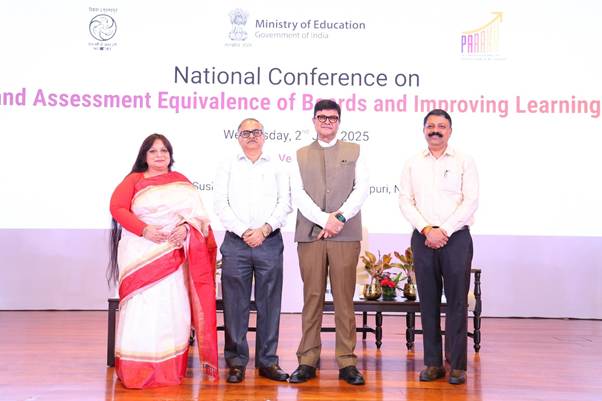
National Conference Held On Assessment Equivalence of Boards And Improving Learning Outcomes
More than 250 officials from Ministry of Education, State Education Departments, State Education Boards, and representatives of CBSE, KVS and NVS take part in the programme.

NEW DELHI: The Department of School Education and Literacy (DoSE&L), Ministry of Education, convened the National Conference on Curricular and Assessment Equivalence of Boards and Improving Learning Outcomes, at Sushma Swaraj Bhawan in New Delhi.

More than 250 officials from the Ministry of Education, State Education Departments, State Education Boards, SCERTs, and representatives from Autonomous Bodies including CBSE, KVS and NVS participated in the programme.
The conference began with an address by Anandrao V. Patil, Additional Secretary, DoSE&L, who emphasised on two core priorities of the National Education Policy (NEP) 2020— transition towards competency-based learning and comparability across school boards.
Sanjay Kumar, Secretary, DoSE&L, chaired the event and underscored the importance of creating mechanisms for ensuring consistency in assessments and academic outcomes across diverse education systems while preserving flexibility for local needs.
He called for a collaborative approach to institutionalise parity and reliability in school-level evaluation practices.
Prof. Dinesh Prasad Saklani, Director, NCERT, explained the foundational role of PARAKH in enabling informed educational reforms.
He highlighted the need to align assessment methods with curricular aims and ensure that data from large-scale assessments supports policy and pedagogy.
PARAKH Rashtriya Sarvekshan Dissemination Portal launched
A major highlight of the conference was the launch of the PARAKH Rashtriya Sarvekshan Dissemination Portal, which provides open access to National and State-level data on student performance.
This tool is expected to serve as a key resource for States/UTs to design targeted improvement plans to enhance learning outcomes and bridge skill gaps.
Prof. Indrani Bhaduri, Head and CEO of PARAKH, presented an overview of the 2024 Rashtriya Sarvekshan findings.
The insights revealed state-wise and district-wise variations in student learning, with attention drawn to foundational literacy and numeracy levels, subject-specific achievements, and areas where interventions have produced measurable gains.
To complement findings from the large-scale assessment with ground level insights, the conference featured best practice presentations by senior officials from Education Departments of six States/UTs.
The conference explored the topic of equivalence of Boards across curriculum and assessment in depth, with a focus on developing robust state-level frameworks and recognition processes.
Institutional self-evaluation
Rahul Singh, Chairperson, Central Board of Secondary Education (CBSE) shared CBSE’s perspective on ensuring quality standards in schools, especially in its capacity as a School Standards Authority. Emphasis was placed on institutional self-evaluation, teacher capacity development, and data transparency to support continuous school improvement.
Prof. Indrani Bhaduri outlined a strategic roadmap for achieving curricular and assessment equivalence across school boards, underscoring its importance in ensuring fairness, mobility and consistency in student evaluation. She emphasised on the establishment of State School Standards Authority (SSSA) in all States/UTs which will ensure that all schools meet minimum quality benchmarks through transparent regulation and implementation of the School Quality Assessment and Assurance Framework (SQAAF).
The conference highlighted implementation of Holistic Progress Cards (HPCs) by States/UTs.
A significant session was dedicated to the recognition of school boards as awarding bodies for vocational courses.
The conference concluded with a vote of thanks by Anusree Raha, Deputy Secretary, DoSE&L, who acknowledged the valuable contributions of all participants and reaffirmed the Ministry’s commitment to fostering coordination between boards, institutions, and states.
Comments are closed.