
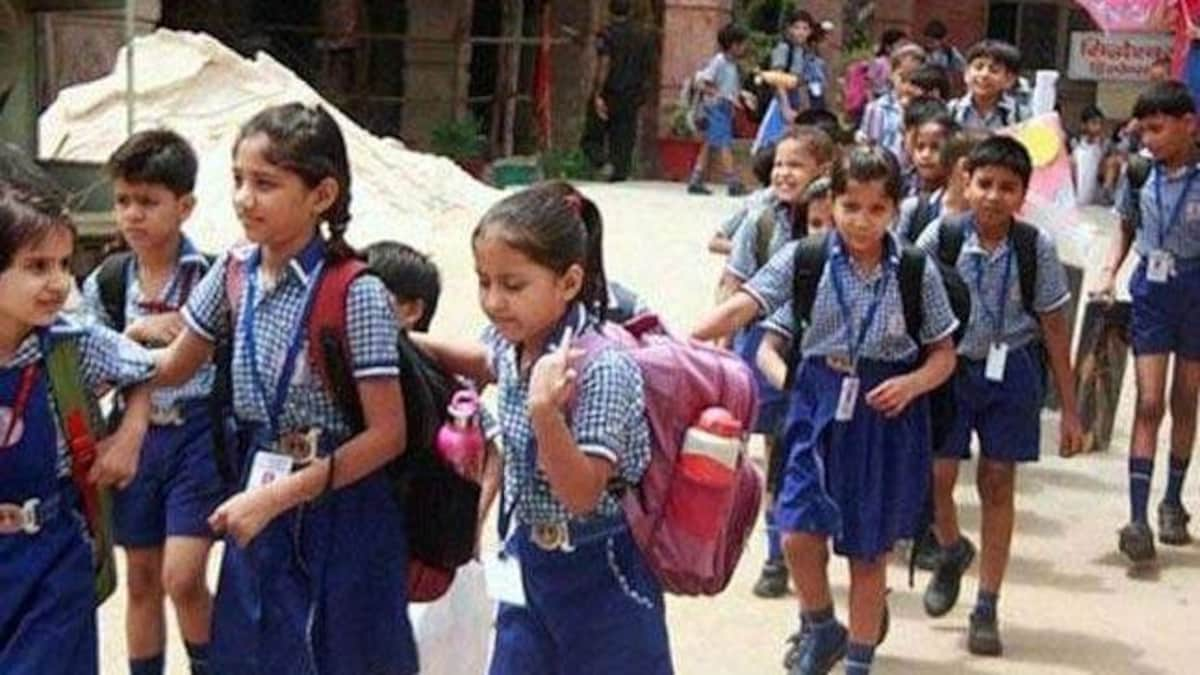
NEP 2020 Has Ushered In A New Era of Schooling
With a slew of initiatives and reforms, India’s GER has reached commendable highs in 2023–24: 97.8% in primary and 96.57% in upper primary

NEW DELHI: With the launched of the National Education Policy 2020 (NEP 2020) on July 29, 2020, India has turned the page on a new chapter in education—one not just of reform, but of reinvention.

Five years ago, the country laid out an ambitious roadmap to transform its schools into spaces where learning is no longer confined to textbooks, marks, or memorization, and it has started yielding the results in the right direction.
By reimagining every element of school education, from curriculum and pedagogy to assessments and teacher development, the policy seeks to restore joy, relevance, and purpose to the learning experience.
The NEP 2020 aligns closely with global commitments such as ‘Sustainable Development Goal 4: ensuring inclusive and equitable quality education for all’. In bridging India’s educational legacy with the demands of the 21st Century, the policy aspires to create classrooms that empower and not just inform.
Key reforms
ECCE and Foundational Learning
Recognising that over 85% of brain development happens before age six, the NEP 2020 focuses on Foundational Literacy and Numeracy (FLN) to ensure the ability to read with understanding and perform basic mathematical calculations by the end of grade three.
The initiatives like National Initiative for Proficiency in Reading with Understanding and Numeracy (NIPUN Bharat) Mission, School Preparedness and Early Childhood Education (Vidya Pravesh), Bal Vatikas provide 3 years of pre-schooling under the 5+3+3+4 structure.
Vidya Pravesh programme promotes school readiness in children entering Grade I through a 12-week play-based module.
For the first time a National Curricular Framework for Foundational Stage (NCF-FS) has been developed for children between ages 3 to 8.
Jadui Pitara is a collection of play based Learning Teaching Material (LTM) like toys, games, puzzles, puppets, posters, etc. for 3 to 6 years age group.
An e-Jaadui Pitara has also been launched, bringing AI-powered and Play-based learning to the foundational stage.
Over 12 lakh teachers have been trained under the NISHTHA teacher training programme.
Vidya Pravesh: 4.2 crore Grade 1 entrants across 8.9 lakh schools benefited from a 12-week play-based school readiness programme.
Balvatikas (preschools): Over 1.1 crore children enrolled; 496 model centres functional in KVs.
Curriculum: NCF-FS adopted by all States and UTs; 121 multilingual primers developed.
Digital tools: 2,778 FLN content pieces on DIKSHA (National ed-Tech platform); e-Jaadui Pitara App launched in 2024.
The impact of these initiatives are reflected in national learning assessments. As per the PARAKH Rashtriya Sarvekshan, 2024, at Grade 3 level, students in State Government schools outperformed those in private and urban schools, with rural children scoring higher than their urban peers in language and mathematics.
As per ASER 2024, Foundational reading levels among Class III children in government schools have reached their highest since 2005: 23.4% children could read Grade II-level text in 2024, up from 16.3% in 2022 and 20.9% in 2018. Arithmetic proficiency has also improved, with 27.6% of Class III students now able to perform basic subtraction, compared to 20.2% in 2022 and 20.9% in 2018
Samagra Shiksha
Pursuing the spirit of ensuring ‘Education for All’, the Central government has revitalised school access and retention through Samagra Shiksha, the integrated scheme spanning pre-primary to higher secondary levels.
India’s Gross Access Ratios (GER) reached commendable highs in 2023–24: 97.8% in primary and 96.57% in upper primary. Further, the dropout rates have decreased with improved school infrastructure— 98.4% of schools now have drinking water, 97.1% girls’ toilets, 85.1% ramps, and 85.1% electricity coverage.
The inclusive hostels have become a vital support system for marginalised learners. India has now 1,137 Netaji Subhash Avasiya Vidyalayas for 1.15 lakh students from socio-economically disadvantaged groups (SEDGs), and 5,269 Kasturba Gandhi Balika Vidyalayas (KGBVs), housing 7.58 lakh girls.
Inclusive classrooms
The launch of PRASHAST, a digital pre-assessment tool, has empowered teachers to identify and support children with any of the 21 disabilities listed in the RPwD Act 2016. Available in both Flipbook and mobile app formats, PRASHAST equips regular and special educators with tools for early intervention—laying the groundwork for inclusive learning environments.
Further, Indian Sign Language (ISL) has been formally introduced as a subject at the secondary level, marking a watershed moment for deaf learners. More than 1,000 ISL videos and talking books across 46 subjects have been developed and made accessible, making learning more inclusive than ever before.
Curriculum Reform
Replacing the old 10+2 model, NEP 2020 ushered in a 5+3+3+4 structure, supported by the NCF-FS (2022) and NCF-SE (2023) frameworks.
Notably, the NCF-s advocate for toy-based pedagogy, interdisciplinary content, and multilingual classrooms, with resources translated into 22 scheduled Indian languages.
The NCFs also recommend vocational exposure from Grade 3 onwards and offers of Vocational Education as a subject from Grade 6 onwards.
To align skill education with regular curriculum the National Credit Framework (NCrF) was notified by University Grant Commission (UGC), and CBSE has notified the Standard Operating Procedure (SOP) for implementing the operationalisation of NCrF For Class 9 to 12 in schools.
Leveraging Technology
DIKSHA (Digital Infrastructure for Knowledge Sharing) provides digital learning resources in 133 Indian languages. The platform supports QR-coded textbooks facilitates self-paced learning. It provides professional development courses like NISHTHA for teachers.
Rashtriya Vidya Samiksha Kendra (RVSK) is a super-connector of systemic school education data generated from State/UT VSKs throughout the country to enable collation and analysis of data for decision making.
Under PM eVidya, 200 DTH TV Channels make quality education accessible to all students across the country
Empowering teachers
NEP 2020 positions teachers as the driving force of school transformation through strengthened recruitment, training, and career progression.
NISHTHA Training: Over 14 lakh teachers trained across ECCE and FLN.
DIKSHA, the national EdTech platform under NEP 2020, provides multilingual teaching resources, interactive lessons, and integrated NISHTHA training modules, supporting educators, students, and parents alike.
Transforming assessment
NEP 2020 transforms assessment by shifting from rote-based exams to continuous, formative, and competency-based evaluation. PARAKH, anchors the shift to competency-based, formative evaluation.
Holistic Progress Cards (HPCs) provide a 360-degree view of student development, covering academics, creativity, socio-emotional skills, and community engagement.
School Quality Assessment and Assurance Framework (SQAAF) aims to Improve quality of schools through five critical domains: Administration, Curriculum, Assessment, Infrastructure, and Inclusiveness.
Comments are closed.