
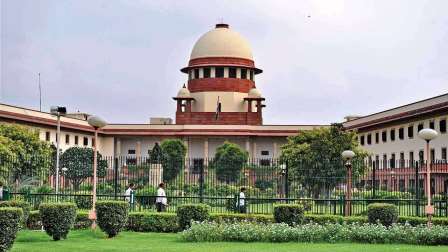
Supreme Court Orders Nationwide Audit Of Private Universities
The court seeks details about disclosure of the legal basis under which each university was established, details of all benefits granted to such institutions, composition and selection process of governing bodies and operational data

NEW DELHI: The Supreme Court of India (SC) has directed the Union government, all States and Union Territories, and the University Grants Commission (UGC) to submit detailed disclosures on how every private, non-government, and deemed university in the country was established, regulated, and monitored.

Now, the Centre, every state and Union Territory, along with the UGC must file affidavits outlining the foundation, management, and operational specifics of such universities.
The landmark order comes in the context of a petition filed by a 23-year-old former student of Amity University, Noida, Ayesha Jain (formerly Khushi Jain), who alleged that after she legally changed her name and submitted the requisite documents, the university refused to update her records.
She claimed that she was barred from attending classes, prevented from appearing for exams, and subjected to harassment — including taunts centered on her adopted name.
According to her petition: she changed her name in 2021, duly published it in the Gazette of India, completed a certificate course in 2023 under the new name, and enrolled in an MBA programme in 2024. Despite complying with formalities, the university allegedly denied the update — costing her an entire academic year.
During initial hearings, the apex court had asked the chairman and vice-chancellor of the trust behind Amity University to personally explain their conduct. But following their affidavits, the court concluded that this was not merely a one-off grievance — rather, the case raised deeper, systemic questions about governance, regulation, and transparency in private higher education institutions across India.
What the Court has demanded
A full affidavit from the Centre, all States/UTs, and the UGC, personally affirmed by their highest officers (Cabinet Secretary for Centre; Chief Secretaries for States/UTs; Chairman of UGC).
Disclosure of the legal basis under which each private/non-government/deemed university was established.
Details of all benefits — land allotments, financial or administrative concessions, preferential treatment — granted to such institutions.
Information on who actually controls and manages these institutions, including composition and selection process of governing bodies.
Operational data: admissions policies, faculty recruitment procedures, compliance mechanisms, grievance redressal systems, remuneration practices, and whether institutions claiming “no profit, no loss” status follow it in reality.
The court warned that any attempt to suppress, misrepresent or withhold facts would be dealt with strictly.
The controversy began with a single student’s name-change dispute, the court observed that the circumstances pointed to possible arbitrary and discriminatory practices, and broader governance failures. The Bench — comprising and — held that in the “larger public interest,” a systemic audit of all private higher education institutions was warranted.
Comments are closed.