
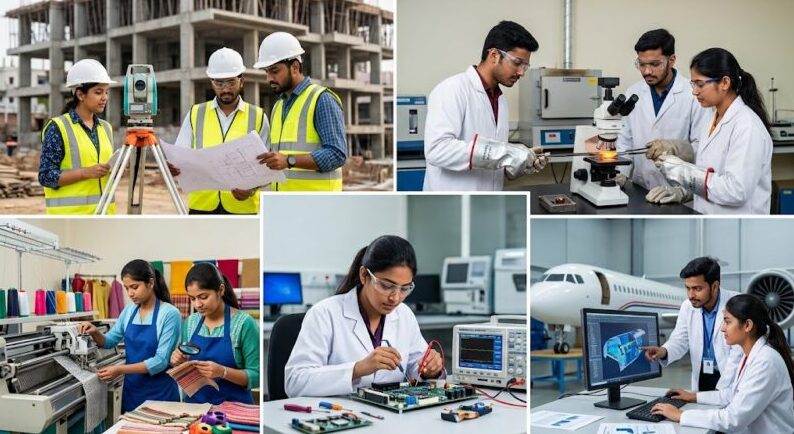
Changing Choices: Why Are These Five Engineering Streams Losing Favour With Students

JEE counselling trends and admission data from engineering institutions reveal an interesting change in student choices for engineering streams. Still one of the top career choices in India, engineering is no longer synonymous with computer science and software, or the traditional “backbones of the discipline” such as Civil, Mechanical and Electrical Engineering.

Even at the IITs, certain branches tend to be chosen later in the counselling process or have comparatively less demand than computer science and other technology-oriented programmes.
Experts say the student preferences have changed with the job market. With the advancement of artificial intelligence, coding, data science and other technology-driven fields, some traditional engineering branches appear to be less attractive among students.
As the job market evolves, students are increasingly looking for courses they believe offer stronger employment opportunities, higher starting salaries and greater career mobility. This has affected the popularity of several traditional engineering disciplines. Here are five such branches.
- Civil Engineering
Civil Engineering has historically been one of India’s most important engineering disciplines, powering the country’s infrastructure, construction and urban development.
However, it often attracts less preference than computer science and other technology-oriented branches at highly competitive institutions. One factor is the nature of entry-level work, which can involve construction sites, fieldwork and relatively modest starting salaries in some private-sector roles.
That does not mean Civil Engineering lacks career opportunities. Infrastructure development, urbanisation and government projects continue to create demand for civil engineers. However, the branch has increasingly struggled to compete with technology-focused disciplines for the attention of top JEE rankers.
- Metallurgy & Materials Science
Metallurgical and Materials Engineering has traditionally played an important role in industries such as steel, manufacturing, mining and materials research.
However, students today have more career options in software, data and emerging technologies. Compared with these sectors, core engineering industries can appear less attractive to students seeking high starting salaries or rapid career growth.
The branch nevertheless has applications across manufacturing, aerospace, automotive, energy and advanced materials, making it an important field despite its relatively lower popularity among engineering aspirants.
- Textile Engineering
India has one of the world’s largest textile and apparel industries, and textile engineering has historically supplied technical talent to the sector.
However, the course has seen comparatively lower preference among students as newer technologies and career fields gain popularity. Students increasingly gravitate towards areas such as software, artificial intelligence, robotics and data science, while textile engineering is more closely associated with manufacturing, production and the apparel industry.
The sector continues to have opportunities in areas such as technical textiles, sustainable materials, manufacturing technology and product development, but these opportunities may be less visible to students than those offered by technology-focused disciplines.
- Aerospace Engineering
Aerospace Engineering combines engineering with aviation, aircraft, satellites and space technology, making it an attractive field for students interested in the sector.
However, career opportunities in India’s aerospace sector remain more limited than those available in the broader IT and technology industries. Many students interested in space and defence may also need to pursue highly competitive opportunities in organisations such as ISRO, DRDO and other specialised institutions.
As a result, Aerospace Engineering can appear riskier to students who prioritise a wider range of private-sector employment opportunities after graduation.
- Biomedical Engineering
Biomedical Engineering sits at the intersection of engineering, medicine and technology. It covers areas such as medical devices, diagnostics, biomedical instrumentation and healthcare technology.
Despite its potential, the field has not gained the same level of popularity among Indian engineering aspirants as computer science and related technology disciplines. One reason is the relatively smaller domestic market for biomedical engineering roles compared with the vast employment ecosystem surrounding IT and software.