
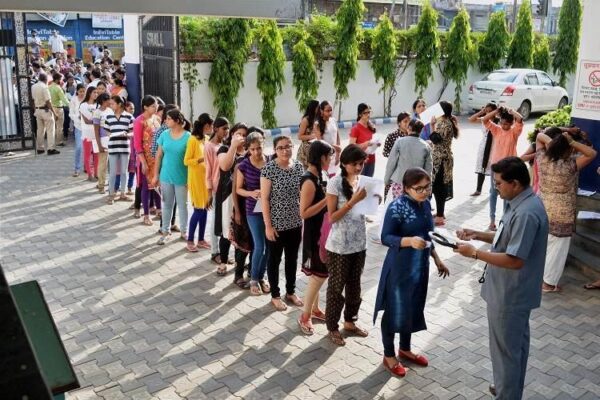
China’s Gaokao Is World’s Largest Examination, NEET UG Ranked 5th: Study
A recent study by State Bank Of India highlights the world’s largest examinations by the number of candidates applying for them

NEW DELHI: China’s national college-entrance examination ‘Gaokao’ is the largest in terms of volume of applicants, a recent study conducted by State Bank of India (SBI) has said.

With 12.9 million candidates appearing for this exam in 2026, Gaokao tops the list of largest exams by volume of applicants, while India’s National Eligibility cum Entrance Test for undergraduate admission (NEET UG), with 2.5 million candidates, is on the fifth position in the table.
The recent study highlights the world’s largest examinations by the number of candidates applying for them. Gaokao is followed by ENEM in Brazil (4.8 million candidates). China’s Guokao (3.7 million) and National master’s entrance examination (3.4 million) are in the third and fourth places respectively.
The study also displays the number of applications submitted for other national-level competitive exams in India such as Joint Entrance Examination (JEE) Main, Union Public Service Commission (UPSC) Civil Services Examination (CSE), and University Grants Commission (UGC) National Eligibility Test (NET) in India.
World’s largest exams: rank table
| Examination | Country | Applications (in million) |
| Gaokao | China | 12.9 |
| ENEM | Brazil | 4.8 |
| Central Civil-Service Examination (Guokao) | China | 3.7 |
| National Master’s Entrance Examination | China | 3.4 |
| NEET UG | India | 2.5 |
| YKS | Türkiye | 2.4 |
| UTME | Nigeria | 2.2 |
| SAT | US / International | 2.0 |
| SSC and equivalent examinations | Bangladesh | 1.8 |
| ACT | US | 1.4 |
| UPSC CSE | India | 1.2 |
| HSC and equivalent examinations | Bangladesh | 1.2 |
| JEE Main | India | 1.0 |
| UPSC-NET | India | 0.8 |
The SBI study has given details of how China conducts the world’s largest competitive examination and its national college-entrance examination ‘Gaokao’ by combining national standards with provincial delivery.
In 2026, a total of 1.29 crore candidates registered in China for Gaokao. The authorities set up 7,981 exam centres, 348,000 examination rooms and 21,000 reserve rooms, with accommodations arranged for more than 14,000 candidates with disabilities.
The study, which was released at a time when Indian examination system is under scrutiny following the NEET UG paper leak and other lapses, also detailed in stringent security measures in place to ensure the smooth conduct of the examination.
Security measures
- Exam papers are drafted and printed in designated, highly secure locations such as state prisons under 24/7 surveillance.
- Papers are moved in armored, GPS-tracked vehicles accompanied by armed police, SWAT escorts, and live-stream monitoring that triggers alarms for any route deviation.
- Upon arrival at test centers, papers are stored in steel-reinforced rooms with motion sensors and alarms linked directly to local police.
- Candidates face identity and prohibited-item checks, with video monitoring in examination rooms.
- Interdepartmental support covers traffic, noise, food, healthcare and severe weather; reserve rooms and emergency power support continuity
- Incidences of documented theft, cheating and disruptions show that it is not entirely failure-proof
Lessons for India
Referring to Gaokao’s paper security, marking controls and emergency arrangements, the study, which examines the structure of National Testing Agency (NTA), offers lessons for India.
India should adapt accountable administration and recovery procedures while protecting candidate rights, rather than assume that surveillance alone prevents failures, the study says.
Audit responsibility and custody: Name accountable officials, accredit centres, certify staff and verify dual authorisation handovers. Test controls against insider failures as well as candidate cheating.
Prepare remedies before disruption: Specify postponement and re-test criteria, secure reserve papers, alternative venues, accessible formats and replacement staff. Protect disrupted candidates in admissions schedules.
Strengthen marking and redress: Pilot anonymous double marking for written components, audit automated scoring and publish understandable moderation rules and time-bound appeals. Provide alternatives when identity technology fails.
Publish evidence and evaluate: Distinguish advance leaks, in-exam sharing and fabricated claims in incident reports. Track disruptions, re-tests, scoring corrections, appeals and costs. Assess inclusion by gender, disability, rurality and SC/ST/OBC category where lawful and privacy-safe.
(Source: SBI Research: The State of Higher Education in India since 2014: Executive Summary)
To view the executive summary document of the SBI study, click here.