

Germany’s ‘Free’ Degrees Can Still Cost Indian Students Rs 70 Lakh: Hidden Expenses Explained

Getting an admission letter from a German public university with near‑zero tuition fees may look like the biggest hurdle is already cleared.

But for Indian families, the real financial challenge lies in the hidden costs that do not appear on the university fee page: rent, food, health insurance, flights, visa charges, semester contributions, and the hefty deposits needed to settle in during the first few months, according to a report by India Today.
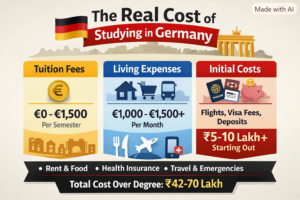
As Karuna Syal, Operations and Support Functions CEO, YES Germany, explains, “There are a number of costs which include not only the tuition cost but other costs like accommodation, travel cost, visa fees, health insurance cost, etc.”
Over the full duration of a degree, these expenses can take the overall cost to Rs 42–70 lakh, depending on the course, university, city and lifestyle.
And more Indian students are now making this calculation. Data from the German Academic Exchange Service (DAAD) shows that the number of Indian students in Germany increased from 28,905 in 2020 to 59,419 in 2025.
So, if Germany is on your study-abroad list, what should actually go into the budget?
LET’S TALK ABOUT ‘FREE’ EDUCATION
It sounds attractive, but ‘free education’ needs a little context.
Many German public universities do not charge tuition fees for several bachelor’s and master’s programmes. But that does not mean every university or every student pays nothing.
For example, non-EU students in Baden-Wrttemberg generally pay €1,500 (Rs 1.63 lakh) per semester. Some universities in Bavaria may also charge tuition fees. Private universities and certain specialised programmes can cost considerably more.
Then there is the semester contribution. This is separate from tuition and varies between universities. It generally covers student services and, depending on the institution, may include transport-related benefits.
In other words, zero tuition does not mean zero university expenses.
THE €11,904 NUMBER IS NOT YOUR TOTAL COST
This is another figure students need to understand correctly.
For students applying for a German study visa in 2026, the financial requirement is generally €11,904 (Rs 12.99 lakh) for one year. This money is meant to show that the student has enough funds to support themselves during their stay.
It is not an extra fee charged by Germany. The money can typically be demonstrated through a blocked account or another accepted form of financial proof.
But there is an important catch for family budgeting: showing €11,904 does not mean the family only needs to keep aside that amount.
There will still be expenses such as flights, accommodation deposits, health insurance, semester contributions, visa-related costs and emergency funds.
Syal says families should prepare for “all kinds of expenditure, including both expected and unexpected” because international education is a major financial investment.
THEN COMES THE REAL MONTHLY BUDGET
For many students, accommodation becomes one of the biggest recurring expenses.
Rent in larger and more popular student cities can be considerably higher, while finding a room itself can be challenging. Students also need to budget for groceries, transport, phone bills, study materials and health insurance.
The first month can hurt the wallet even more.
A student may have to pay a deposit for accommodation, buy basic household items, arrange local transport and manage everyday expenses before settling into a routine.
That is why Indian students should think beyond “How much is the tuition fee?” and ask a more useful question: “How much will I actually need every month?”
THE COST CAN CHANGE EVEN BEFORE YOU REALISE IT
There is another factor Indian families cannot control: the euro-rupee exchange rate.
“Exchange rate fluctuations are one of the factors that most families ignore,” Syal says, adding that the effect of exchange rate movements can have a significant impact on the overall cost once expenses are converted from rupees to foreign currency.
She recommends budgeting for initial settlement, monthly expenses, contingencies and academic requirements rather than treating the entire amount as one lump sum.
“Rather than budgeting based on exchange rates, parents need to set aside a budget. This budget can be divided into several sections such as initial settlement, monthly expenses, contingency budget, and academic needs,” she says.
HOW MUCH SHOULD STUDENTS KEEP ASIDE?
There is no single figure that works for every German university or student.
A student living in a smaller city, sharing accommodation and managing expenses carefully could have a very different budget from someone studying and living in an expensive city.
The course duration also matters. A two-year master’s degree will naturally have a different total cost from a longer programme.
For families, the smarter approach is to calculate the expenses in stages: admission and documentation, visa and financial proof, travel, initial settlement, monthly living costs, university contributions and an emergency buffer.
Germany can certainly reduce the tuition burden for many students. But the word “free” should never become the family’s entire financial plan.
The real question is not “Is tuition free?” It is, “Can we comfortably afford everything around it?”