
IIT Gandhinagar Students Develop AI-based ‘TrustGate’ To Protect Critical Infrastructure From Cyberattacks
Developed by Miloni Thakkar and Mitwa Goswami, ‘TrustGate’ system combines network traffic and physical sensor data to identify anomalies, determine the equipment affected and provide real-time information

NEW DELHI: Two undergraduate students of the Indian Institute of Technology (IIT) Gandhinagar have developed an AI-based cyber security system to identify cyberattacks on critical establishments, such as water treatment plants, power grids and manufacturing facilities.

Titled TrustGate, the AI-based system converge network traffic and physical sensor data to detect attacks, determine the equipment affected and provide real-time information to the plant operators concerned.
Third-year computer science and engineering student Miloni Thakkar and electrical engineering student Mitwa Goswami developed TrustGate to address a gap in conventional industrial control system security infrastructure.
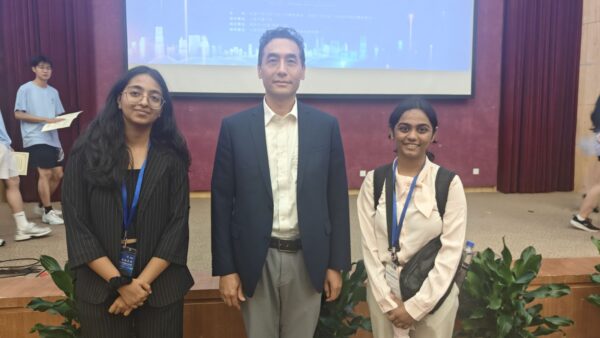
The students have begged the second prize at the Intel Cup, the international Undergraduate Electronic Design Contest 2026, recently held at Shanghai Jiao Tong University in China, said a Press Information Bureau (PIB) release.
Such tools generally monitor network traffic and can detect unauthorised access, unusual activity or known malware.
However, they may not be able to identify whether a command that appears legitimate at the network level could have dangerous physical consequences for a critical infrastructure.
“TrustGate closes that gap by understanding both the cyber and physical sides of an attack together,” Miloni Thakkar said.
The project was partly inspired by a 2021 cyberattack on a water treatment plant in Oldsmar, Florida, where an unidentified attacker remotely accessed the control system and tried to raise the level of sodium hydroxide to nearly 100 times of the permissible concentration.
The attack was not detected by an automated security system and was noticed only after a plant operator saw the computer mouse moving on its own and reversed the command.
How TrustGate works
TrustGate uses a dual-stream Bi-directional Long Short-Term Memory (BiLSTM) model combined with “cross-modal attention”. It analyses network traffic and physical sensor readings as two separate streams and allows them to inform each other.
This enables the system to detect attacks that may not appear clearly suspicious in either network data or physical sensor readings alone, including gradual manipulations designed to avoid triggering an alarm.
In case of an anomaly, TrustGate identifies the likely nature of the attack and the specific physical component affected and displays the information on a live map of the plant.
The students used the SWaT (Secure Water Treatment) dataset for testing. It is based on a scaled-down six-stage water treatment testbed maintained by the iTrust Centre at the Singapore University of Technology and Design, and is widely used in industrial control system security research.
𝐈𝐈𝐓𝐆𝐍 𝐓𝐞𝐚𝐦 𝐒𝐞𝐜𝐮𝐫𝐞𝐬 𝐒𝐞𝐜𝐨𝐧𝐝 𝐏𝐫𝐢𝐳𝐞 𝐚𝐭 𝐈𝐧𝐭𝐞𝐥 𝐂𝐮𝐩 𝟐𝟎𝟐𝟔
IIT Gandhinagar undergraduate students 𝐌𝐢𝐭𝐰𝐚 𝐆𝐨𝐬𝐰𝐚𝐦𝐢 from the Department of Electrical Engineering and 𝐌𝐢𝐥𝐨𝐧𝐢 𝐓𝐡𝐚𝐤𝐤𝐚𝐫 from the Department of Computer Science and… pic.twitter.com/MWU7BBVfqJ
— IIT Gandhinagar (@iitgn) August 20, 2026
Since critical infrastructure may be kept offline for safety reasons, TrustGate has been designed to operate entirely on embedded hardware rather than relying on cloud connectivity.
The system uses TPM 2.0 to verify the integrity of its code and hardware at boot and has a self-healing watchdog that automatically restarts a core process if it hangs or crashes.
Mitwa Goswami led the hardware integration, TPM attestation and embedded Linux deployment, while Miloni Thakkar led the AI model architecture, training, testing and OpenVINO deployment.
They were mentored by Dr Sameer Kulkarni, Assistant Professor at IIT Gandhinagar.
Teams at the international round were required to build a working system on Intel’s DK-2500 hardware platform, submit a technical report and defend their work before an expert judging panel.
As of now, TrustGate is a research prototype validated on a laboratory testbed. It needs testing on live plant data, support for more industrial protocols and formal security certifications before it can be piloted at a real facility.